










If you run a fleet, you’ll know how quickly fuel costs can add up. With UK diesel currently averaging around 182p–183p per litre and unleaded at roughly 161p–162p, keeping vehicles on the road is becoming an increasingly expensive part of running a business.
And it’s not just the price itself. Fuel costs can change quickly, putting pressure on fleet budgets and making it harder to forecast operating costs with confidence. For businesses covering hundreds or thousands of miles each week, even small changes at the pump can quickly add up.
Why are fuel prices rising?
There’s no single reason behind the current pressure at the pump. Global oil supply has been affected by geopolitical tensions and disruption to key shipping routes, while OPEC supply decisions, exchange rates and refining costs are also influencing what drivers pay.
Fuel duty is another factor. The government’s temporary 5p per litre cut has been extended until 31 December 2026, with rates then scheduled to increase in stages from January and March 2027.
For businesses running multiple vehicles, these changes can have a noticeable impact, particularly across a fleet with a heavy weekly mileage.
Regulation is changing too
Fuel costs aren’t the only reason fleet operators are looking at electrification. Regulation is also accelerating the market’s shift towards zero-emission vehicles.
Under the UK’s Zero Emission Vehicle (ZEV) mandate, 24% of new van registrations must be zero-emission in 2026, rising to 70% by 2030.
For businesses planning vehicle replacements over the next few years, understanding how the market is changing and what charging infrastructure they may need is becoming increasingly important. Starting to plan now can help businesses make informed decisions about which vehicles and charging infrastructure will work for their operation.
What does this mean for fleet operators?
Fuel can account for a significant proportion of a fleet’s running costs, so rising prices can have a direct impact on the bottom line.
For many businesses, this is prompting a closer look at fleet electrification, not only as a way to reduce emissions but as an opportunity to rethink one of their biggest running costs.
How do EV running costs compare?
Charging an EV at a depot or workplace using an off-peak electricity tariff can typically cost around 3p–8p per mile, compared with around 17p–23p per mile for petrol vehicles based on current prices.
Public rapid charging can cost more, However, businesses that can charge vehicles at their own premises have much greater control over when and how they charge. This can make a significant difference to the overall cost of running an electric fleet, particularly when businesses have the right EV charging infrastructure in place.
There’s also financial support available to help businesses make the transition. The Workplace Charging Scheme increased to £500 per socket from April 2026, covering up to 75% of eligible costs and running until 31 March 2027. The government is also providing financial support, including discounts of up to £5,000 on eligible zero-emission vans and funding towards depot charging infrastructure through the Depot Charging Scheme. The scheme’s first 2026 application window covered 70% of eligible ChargePoint and civil costs, up to £1 million, with a further application window expected to open in October 2026.
The government has explicitly framed this funding around helping businesses build resilience against fuel-price uncertainty, not just as an emissions measure.
What could this mean in practice?
Pence-per-mile figures are useful, However, the real question for most fleet managers is what the switch could actually save in pounds.
For a fleet covering 20,000 miles per van each year, for example, the difference in energy costs could look like this:
- Diesel, at around 17p–21p per mile, costs roughly £3,400–£4,200 a year in fuel
- EV charging at a depot or workplace, at around 3p–8p per mile, costs roughly £600–£1,600 a year in electricity
That’s a difference of somewhere between £1,800 and £3,600 in energy costs per vehicle, per year. Across a fleet of 20 vehicles, even the conservative end of that range adds up to well over £30,000 annually.
Potential energy-cost difference: £1,800–£3,600 per vehicle, per year
These figures are illustrative rather than exact. Actual savings will depend on tariffs, vehicle efficiency, mileage and charging patterns, and don’t yet account for other running costs like maintenance, insurance or vehicle finance.
Electric vans also tend to cost less to maintain, with fewer moving parts, no oil changes and reduced brake wear from regenerative braking. Industry estimates put electric van maintenance at roughly 30–45% lower than diesel equivalents over the vehicle’s lifetime.
However, EVs aren’t automatically cheaper in every area of fleet ownership. Insurance, vehicle purchase prices and charging infrastructure can all affect the overall business case, so businesses should compare total cost of ownership rather than fuel costs alone.
Is an EV right for every fleet?
Not necessarily. The right approach depends on how vehicles are used, including daily mileage, payload, routes and whether vehicles return to base regularly.
However, for many fleets, the numbers can make a strong case. Department for Transport research shows around half of all vans in Great Britain travel only about 15 miles from their based on a typical day, with average annual van mileage at around 13,000 miles. For many applications, current electric vans can comfortably cover these kinds of daily distances.
That doesn’t mean every vehicle is automatically suitable. High-mileage routes, heavy payloads and vehicles that spend long periods away from base may require a different approach. That’s why understanding how vehicles are used, before choosing vehicles and charging infrastructure, is an important part of planning an EV transition.
What does fleet electrification look like in practice?
Fleet electrification doesn’t necessarily mean installing a bank of rapid chargers. The right setup depends on how vehicles are used and when they need to be ready to leave.
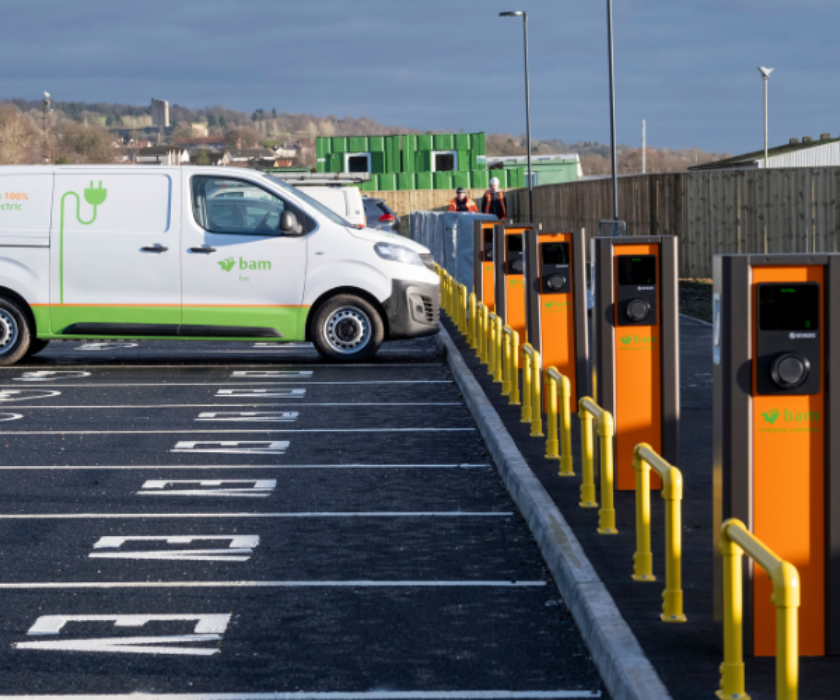
At BAM Charging Solutions’ new headquarters in Kilsyth, Sevadis installed 32 AC charge points across 16 custom pillars, alongside a 100kW DC fast charger for quicker top-ups when needed, combining everyday depot charging with faster charging for vehicles that need it.
Charging infrastructure is part of the strategy
Switching vehicles is only one part of fleet electrification. Businesses also need to consider where vehicles will charge, when they need to be ready to leave, and whether their existing electrical capacity can support the additional demand.
Smart charging and load management can help businesses make better use of available power, particularly where multiple vehicles need to charge at the same time. Dynamic load balancing automatically monitors a site’s overall electricity usage and adjusts how much power goes to each charge point in real time, which can help businesses maximise available electrical capacity and potentially reduce the need for costly grid upgrades. Planning the infrastructure alongside the vehicle transition means businesses can avoid simply replacing one fleet with another without considering how it will operate day to day.
Why start planning your transition now?
Fuel prices won’t necessarily continue to rise every month. They fluctuate and they can come back down.
However, that’s exactly the challenge for fleet operators. When one of your biggest running costs is difficult to predict, planning ahead becomes harder. At the same time, the market is moving towards zero-emission vehicles, with the ZEV mandate requiring an increasing proportion of new vans to be zero-emission each year.
You don’t need to electrify your entire fleet overnight. A good starting point is often vehicles with predictable routes and regular depot returns, particularly those currently costing the most to run. Starting with a smaller group can help businesses understand the costs, charging requirements and operational impact before scaling up.
FAQs
Is it cheaper to run an electric fleet than a petrol or diesel fleet?
In many cases, yes. Charging at a depot or workplace on an off-peak tariff can typically cost around 3p–8p per mile, although actual costs will vary depending on electricity tariffs, vehicle efficiency and charging patterns.
What grants are available for fleet EV charging in the UK?
The Workplace Charging Scheme covers up to 75% of installation costs, capped at £500 per socket, and the Zero Emission Truck and Van grants and the government’s Depot Charging Scheme offer further support for vehicle purchase and depot infrastructure.
Why are UK fuel prices rising in 2026?
A combination of factors, including geopolitical disruption to global oil supply, OPEC decisions, exchange rates and planned changes to the temporary fuel duty cut, are all contributing to higher and less predictable pump prices.
How much charging infrastructure does an electric fleet need?
It depends on fleet size, vehicle usage, charging windows and the site’s available electrical capacity. A fleet returning to base overnight may have very different requirements from one operating continuously throughout the day. Assessing these factors before installing charge points can help businesses choose an infrastructure setup that works now and can scale as the fleet grows.